A Decade Later: One Fan's Return to Upton Park and the Weight of West Ham's Lost Home
The District Line pulls eastward on the last Saturday of January, and with each passing stop, the knot in my stomach tightens. Upton Park is next. There's that peculiar cocktail of dread and anticipation – the feeling of bumping into someone from your past whom you're not quite sure you want to see.
I haven't set foot here since May 2016, when West Ham played their final match at the ground. I'm not making this pilgrimage out of idle curiosity about London's newest housing development. Rather, I'm drawn by something less tangible – the need to understand why a place I left a decade ago still occupies so much space in my head.
Thomas Wolfe wrote that you can never go home again. The past changes, we change, and the attempt to recapture it is futile. But I'm willing to test that theory.
From Aldi checkouts to Saturday salvation
Growing up in Bristol, trips to Upton Park were twice-yearly events until my dad and I became season ticket holders in 2012. For three formative years – sixth form, university, working checkouts at Aldi – I was stuck at home while most of my mates had scattered. Nights out were scarce. Romance was non-existent. My life felt suspended, waiting to properly begin.
Those Saturday matches became my lifeline. Gary Neville once spoke about contextualising pre-match nerves by reminding himself he'd be having a Chinese meal within hours. For a painfully shy teenager, the Aldi till was torture – my face would redden like a Dulux paint sample, with nowhere to hide and customers always ready to comment. The antidote was simple: West Ham on Saturday.
We developed a ritual. Drive to Acton Town or catch the Tube from Paddington, purchase a programme at Upton Park station, then turn left for a Dixy's Chicken fillet burger with fries and that peculiar ketchup-mayo mixture. Grab the latest Over Land and Sea fanzine, slip down Tudor Road to avoid the Green Street chaos, navigate past the East Stand's creaking turnstiles and Priory Park, and finally enter the Bobby Moore Lower.
The air outside reeked of fried onions, stale beer, and horse manure. Inside, the atmosphere was unsparing – I once caught spittle on the back of my neck when a frustrated fan had seen enough after ten minutes of a match West Ham were actually winning 1-0.
There were forgettable nights too. Allardyce-era stalemates that felt like they were playing out in some alternate dimension. But the highlights? Those I'll carry forever. Mohamed Diame's performance against Chelsea. Morgan Amalfitano's winner against Liverpool. Toppling title-chasing Tottenham in 2016. Andy Carroll's hat-trick in that visceral 3-3 with Arsenal. And the final, achingly bittersweet rendition of Bubbles.
The results almost didn't matter. Every visit was sacred.
The silence is deafening
The platform empties, and I notice the old signs reading 'West Ham United Football Club' still faintly visible beneath their modern replacements. It's an uneasy coexistence – past and present refusing to fully separate, mirrored throughout the neighbourhood.
Walking onto Green Street is a bittersweet jolt. I don't need my phone for directions; Queen's Market is exactly as I remember it, the terraced houses unchanged. But I'm delaying the inevitable. When I finally look, there's Upton Gardens – 842 flats across 15 brown and grey buildings, each named after a historical West Ham figure. Where the pitch once sat, there's now a 'No Ball Games' sign. The irony is almost cruel.
Time has left its marks everywhere. My old turnstile is now a power generator. The Hammers Social Club has transformed into a fitness centre. 'West Ham's Favourite Burger Bar' now sells smash patties – the takeaway trend of the 2020s.
What strikes hardest is the quiet. It's reflective, certainly, but also unsettling when you know what this silence has replaced. There's an eerie solitude to it all – suddenly I'm aware I'm the only West Ham fan here, on a pilgrimage nobody else is taking.
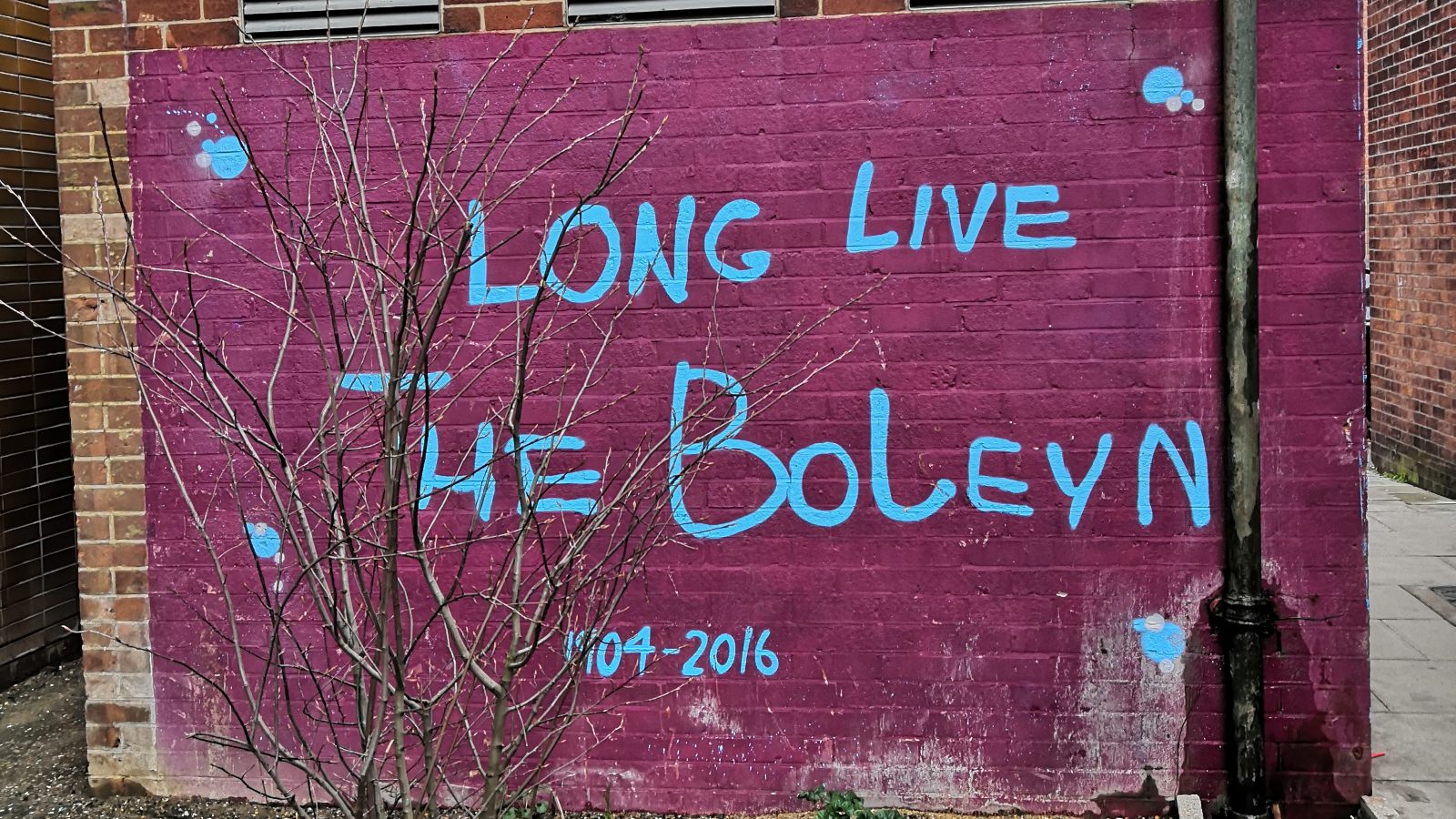
A few old badges on shopfronts and some murals – the Bonds and Brooking one is genuinely moving – hint at what was. But it's hard to imagine a football ground ever existed in this residential area. The planning meeting alone would be a nightmare in today's climate.
Nobody around me is drowning in nostalgia. Yet society has become consumed by it. Documentary maker Adam Curtis observed in a 2025 interview that we're constantly replaying fragments of the past through the internet. He used the example of old comedy shows, noting that much of the audience responsible for the canned laughter is now dead. "It's like a haunting," he said.
Walking back up Green Street, I understood what he meant. You can watch old highlights whenever you want, retreating into a digital realm where Upton Park still stands. Memories blur with these endless fragments. There was actually a part of me that believed the old ground was still there, living on in my head and on screens. As Curtis put it, the fog of experience has been thickened by recorded data that refuses to let the recent past fade away.
I'd been daydreaming about this place for years, returning mentally whenever life disappointed me. But Wolfe was right. You can't go home again.
The unhappy marriage continues
West Ham have become hypernormalised – a term Alexei Yurchak used to describe the Soviet Union's final days. Everyone knew the system was failing, but nobody had a convincing alternative, so the pretence of normality continued.
That's West Ham now. The boardroom speaks in grand terms, attendance figures are massaged, but everybody knows the stadium move has been a failure. Like most season ticket holders, I've tried to make peace with the London Stadium. Sevilla was genuinely unforgettable. But mostly it's been bleak. On good days the experience is merely tolerated. Otherwise, it's a painful reminder that West Ham abandoned their home for a venue that will never truly feel like theirs.
Nobody knows what comes next. There's talk of minor tweaks – cosmetic fixes on a bullet wound. Some point to continental examples: Juventus demolished their unloved Stadio delle Alpi for a purpose-built ground. Stuttgart, Seville, and Buenos Aires have all removed running tracks recently.
But West Ham don't own the London Stadium. They're trapped, able to make only superficial changes.
Fan discontent has simmered constantly since 2016, never far from boiling point. It's the definition of an unhappy arranged marriage.
The path forward must lead away from this arrangement. Whether the stadium is remodelled without its running track or new owners build elsewhere, the current setup offers no genuine vision of improvement.
As Curtis suggested, sometimes the most radical thing you can do is forget the past and move on. That's possible – but only when West Ham have somewhere that feels like home. Only then can Upton Park finally rest in peace.
Compare options