Slot's Tactical Reckoning: How Liverpool's PSG Collapse Exposed a Manager at War With Himself
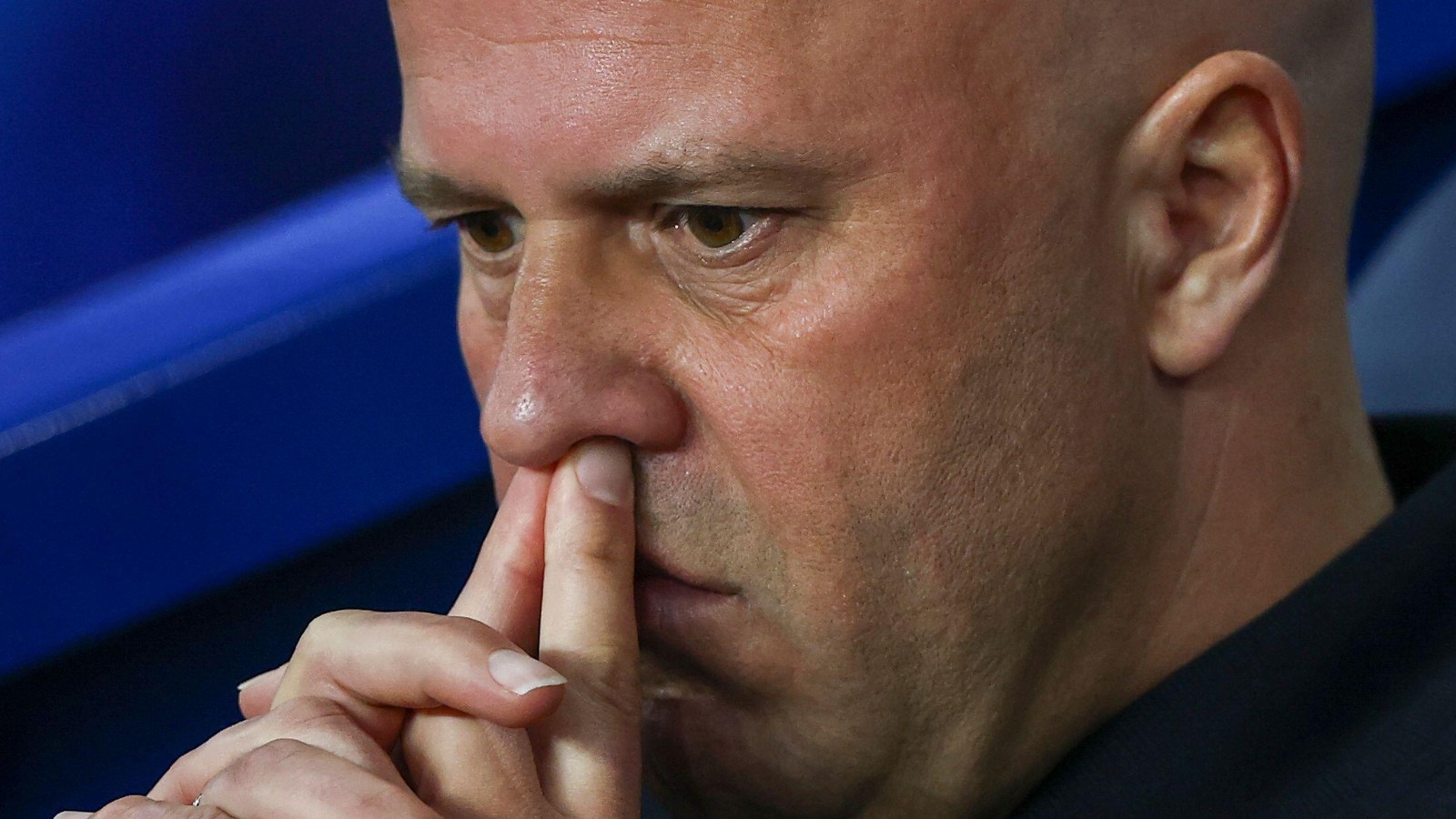
Arne Slot walked into the Parc des Princes with a clear vision of how football should be played. He walked out having surrendered to the very pragmatism he claims to despise, leaving his side dismantled and his credibility in tatters.
The 2-0 defeat to PSG in the Champions League quarter-final first leg wasn't merely a bad result. It was a comprehensive dismantling that exposed something far more troubling: a manager whose words have become increasingly at odds with his actions.
Jamie Carragher didn't mince words in the aftermath. The performance "should have been five or six," he suggested, comparing Liverpool's display to "watching a team from a lower division." The gulf in class, he noted grimly, was "very worrying from a Liverpool point of view."
The tactical blueprint proved disastrous. Slot's decision to deploy a back five left even Virgil van Dijk visibly uncomfortable—a rare sight in a Liverpool shirt. Carragher observed that the centre-back would likely be "pleading" with his manager never to revisit the system, having found it so difficult to operate within. Van Dijk's struggles were symptomatic of a wider malfunction; Liverpool were actually more exposed defensively with five at the back than they would have been with four.
Slot himself acknowledged the scale of the capitulation, admitting they were "lucky with only losing 2-0." But the numbers told an even starker story: PSG managed 18 shots to Liverpool's three, controlling 74 per cent of possession while the visitors barely mustered a quarter of the ball.
Yet the most damning evidence lies not in the scoreline, but in Slot's own words from earlier in the campaign—statements that now read like an indictment of his own management.
The Paris Obsession
Before a goalless draw with Arsenal in January, Slot couldn't resist returning to his favourite subject: PSG. Unprompted, he waxed lyrical about what he termed "the best game of football I was ever involved in."
"My football is Paris Saint-Germain vs. Liverpool, Liverpool vs. Paris Saint-Germain," he declared. "That is how I would love to have every single game."
He contrasted these encounters with the more conservative Premier League fare, lamenting matches against sides employing long balls and low blocks. Fulham, he suggested, was a joyless affair by comparison. PSG, though, represented the kind of open, attacking spectacle he craves.
When the moment finally arrived to face his ideal opponent in his ideal contest, Slot bottled it entirely.
The Attacking Football Paradox
Around the same time, Slot bristled at suggestions that Liverpool had become tedious to watch. He acknowledged hearing the criticism but pushed back firmly: "I would use different words and I would take certain things into account. I want to win as many trophies as I can, but I think I'm also known for the fact that my teams always try to play attacking football."
Against PSG, Liverpool failed to register a single shot on target—a first in European competition since November 2020. They didn't manage a shot of any kind in the opening 45 minutes, a drought unmatched since April 2021. Khvicha Kvaratskhelia alone had seven attempts; Ousmane Dembele and Achraf Hakimi matched Liverpool's total of three. Even substitute Desire Doue managed four.
Slot later described his team as being "in survival mode for large parts of the game," dependent on PSG's wastefulness in front of goal. It's difficult to square that admission with his stated commitment to attacking football.
The Impossible Task
The manager had previously acknowledged the difficulty of implementing dramatic tactical changes mid-season. In November, he'd argued that switching to a five-man defence would be "almost impossible" given the relentless fixture list and minimal training time available.
"The system we are playing now suits the players best," he'd reasoned. "They have played this system probably throughout their whole career, and there is hardly any training time for us."
Yet against PSG, he did precisely what he'd described as nearly impossible, apparently abandoning the principles he'd spent months defending. His post-match justification—that "every tactic has been tried over here but the result is always the same: Paris Saint-Germain blowing the opponent away"—rings hollow when PSG have drawn with 10-man Monaco, lost 3-1 at home to the same side in Ligue 1, suffered defeat to Bayern Munich at their own ground, and conceded three times to Tottenham in a November loss.
The Salah Slight
Perhaps most revealing was Slot's treatment of Mohamed Salah. Earlier in the season, defending his attacking credentials, he'd stated: "If I am known for one thing then it is attacking football, playing a lot of attackers and bringing a lot of attackers in when we are a goal down. So I find it hard to hear that we play boring football let alone that I am not playing attackers."
At 2-0 down with the tie slipping away, Slot made four substitutions in the 78th minute. His final change, in stoppage time, was to introduce Trey Nyoni for Jeremy Frimpong—keeping Salah firmly on the bench. His reasoning: "In the last part of the game, it was more about surviving for us than there was ever a chance that we could score."
It was a decision that betrayed everything he'd previously claimed to stand for.
The Set-Piece Hypocrisy
In early March, Slot had spoken passionately about his distaste for the Premier League's reliance on set pieces and long throws. "My football heart doesn't like it," he confessed, waxing nostalgic for Barcelona's glory years under Pep Guardiola.
Yet against Barnsley in the FA Cup, Slot deployed Joe Gomez specifically to "add some set-piece quality," with the defender's lengthy throw-ins disrupting PSG's rhythm—precisely the kind of tactic Slot had previously lamented as antithetical to beautiful football.
The Barnsley Contradiction
Perhaps most revealing was Slot's complaint about opponents changing their shape against Liverpool. After the Barnsley win, he griped that teams consistently deviate from their established systems when facing his side, unlike in European competition where opponents maintain their usual approach.
"I did not change our style, but teams have changed their style against us," he insisted, noting that Barnsley switched to a back five despite typically playing 4-3-3.
PSG manager Luis Enrique, unbothered, simply noted: "It's the first time they play with five at the back. But we are used to seeing other teams change formation to play against us, it's normal."
The irony was suffocating. Slot had just done precisely what he'd criticised Barnsley for doing—abandoning his principles in response to an opponent. The only difference was the scale of the failure.
Carragher's assessment lingered: it was like watching a team from a lower division. Slot, it seems, has lived long enough to become the very thing he'd spent the season criticising.
Compare options