Manchester United's Unlikely Title Credentials and the Premier League's Mid-Season Reckoning
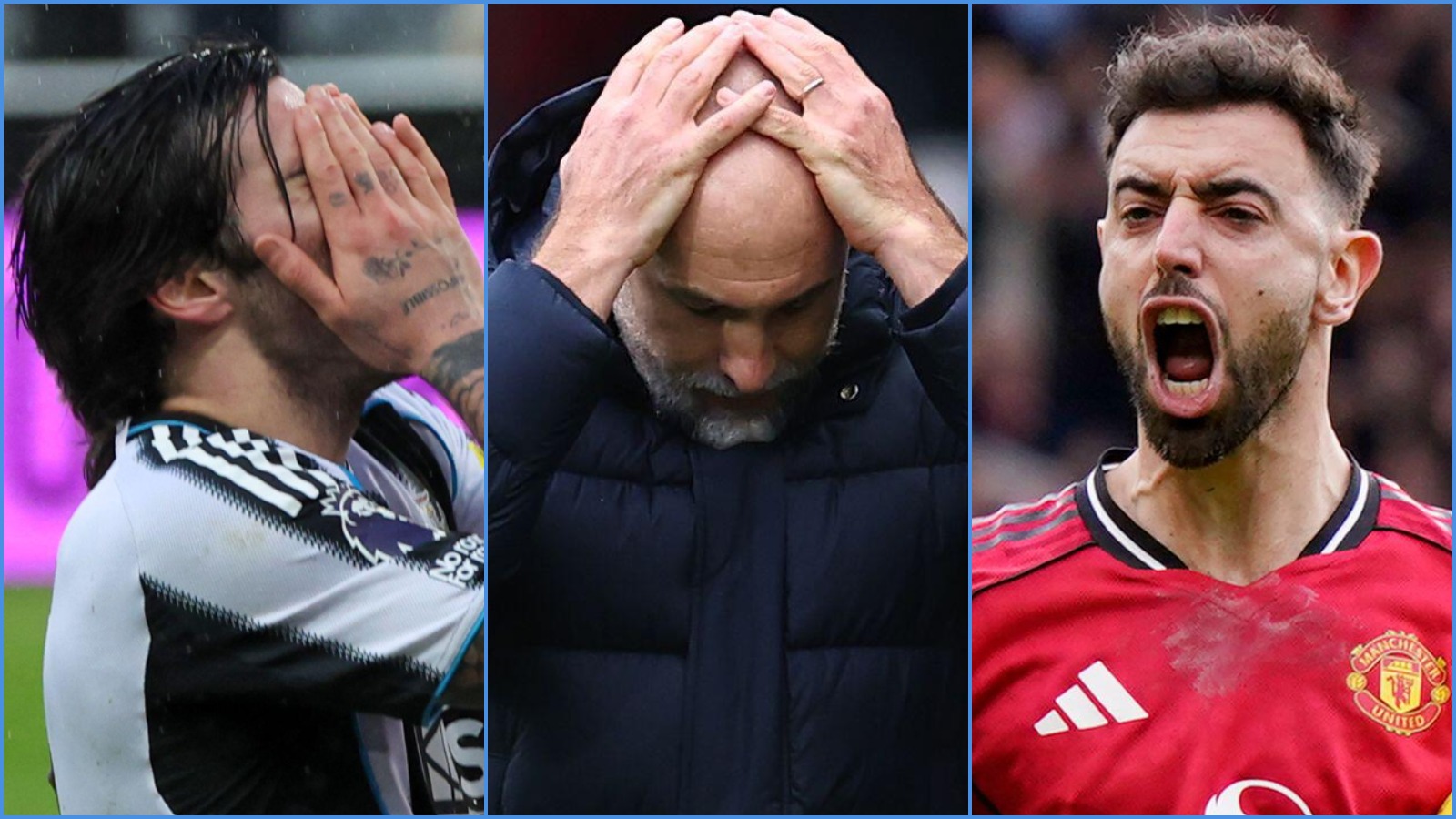
Winners
Wolves
What began as potentially the darkest chapter in Premier League history has transformed into something altogether different under Rob Edwards. The club's destructive force has become their salvation—humiliating draws have toppled Ruben Amorim and Sean Dyche, while simultaneously derailing Arsenal and Aston Villa's ambitions. There's a perverse brilliance to Wolves' logic: if they cannot prosper, nobody else shall either.
Edwards himself has climbed to third-worst managerial record in Premier League history by points-per-game average (0.63), behind only Vincent Kompany (0.63). The prospect of Bayern Munich facing a Real Madrid side managed by Edwards (0.66) in next season's Champions League final has an almost scripted quality to it. His dressing-room theatrics following recent victories carry the hallmarks of a redemption narrative waiting to be written.
David Raya
Mikel Arteta's words after Raya's December heroics against Brighton said it all: "That's what we need from players, we need those performances in the key moments." The Arsenal keeper has become indispensable when the pressure mounts, yet remains criminally overlooked in conversations about England's finest goalkeepers—let alone Europe's elite.
Manchester City
City's record without Erling Haaland reads impressively: 14 wins, two draws and two defeats since his arrival. Yet the supporting cast has shifted dramatically. Phil Foden and Kevin de Bruyne managed six goals apiece in those games, while Bernardo Silva, Julian Alvarez and Jack Grealish each contributed four. Three have departed, one warmed the bench, and another captained from the sidelines as Antoine Semenyo seized his moment to announce himself as a principal attacking threat.
Manchester United
Nobody has strung together a longer unbeaten run than Manchester United's current 11-game sequence. Remarkably, four of these matches occurred under Ruben Amorim and Darren Fletcher before Michael Carrick's arrival, suggesting the underlying quality was always present—merely obscured by tactical incoherence.
The squad possesses all the requisite components: a reliable goalkeeper, a competent defence, a sophisticated midfield, a potent attack and a captain finally leading by example. It's enough to position them as the country's third-best outfit.
Jordan Pickford
The Tony Yeboah of goalkeeping. Everyone's saying it.
Liverpool
There was something distinctly absurdist about Liverpool's performance against West Ham—struggling through open play before dismantling them via set pieces. Arne Slot openly celebrated dead-ball situations as "the reason we won," a curious stance given his earlier criticism of Newcastle's reliance on such methods.
The improvement in set-piece efficiency represents a genuine correction to their season-long vulnerability. Aaron Briggs' departure as set-piece coach clearly stung, though Liverpool's newfound potency suggests the adjustment has borne fruit. Slot still faces considerable challenges: Mo Salah's creative drought, the absence of open-play invention, and his own tendency toward ill-advised media pronouncements. But the dead-ball revolution is real.
Fulham
Fulham maintain a perfect record against the bottom five, a distinction no other club can claim. They've learned from last season's Ipswich encounters to maximise points against relegation fodder more effectively than their rivals. With West Ham, Nottingham Forest and Burnley looming, Fulham could extend that immaculate run and catapult themselves into European consideration.
Brentford
Only Chelsea score more goals relative to their point total, though nothing they accomplish warrants serious consideration. Keith Andrews' side represents the best-coached attacking unit outside the elite tier—and even that qualifier feels redundant when observing their offensive prowess.
Their forward line has been reimagined multiple times without losing potency. Igor Thiago leads the charge, Mikkel Damsgaard supplies the ammunition and Kevin Schade completes the ensemble. For a club perpetually reinvesting after losing talent, their current attacking iteration may be their finest yet.
Eddie Riemer
Leeds' assistant manager deserves credit for confronting the booing at Elland Road without deflection. Whether supporters objected to Pep Guardiola's use of a stoppage break or simply feared a repeat of the previous fixture's "fake injury" controversy, Riemer refused to hide behind platitudes. Challenging tribalism from within an organisation is commendable.
Bournemouth
Two eight-game unbeaten streaks separated by an 11-match winless drought—an extraordinary feat of inconsistency. Only the opening-day Liverpool encounter sits outside these three sequences. Arsenal, Manchester United, Liverpool and Manchester City have longer unbeaten runs; only Burnley and Wolves have endured longer without victory. Andoni Iraola's answer to "how's the bacon?" would inevitably be: "streaky."
Marcus Tavernier
His crosses deserve a seat alongside James Hill on England's World Cup plane.
Sunderland
Among four clubs yet to lose from a winning position this season, Sunderland have become a different proposition with Granit Xhaka's arrival.
Danny Welbeck
At 35, Welbeck remains that man rather than the alternative—no bad thing whatsoever.
Losers
Igor Tudor
Tudor's rescue operations typically yield immediate improvement. Yet Spurs represent his first genuine crisis. In seven previous assignments, only one began with defeat—back in 2013. Opening with consecutive losses at Tottenham signals the magnitude of this undertaking.
Alarming patterns have already emerged. Playing Conor Gallagher and Xavi Simons as wide midfielders whilst deploying Archie Gray at left-back suggests tactical confusion rather than systematic clarity. His post-match explanations—blaming opposition "cheating" and "home referees" whilst simultaneously admitting fundamental deficiencies in attack, midfield and defence—ring hollow. It's convenient to claim problems transcend systems when he was appointed specifically to solve them.
Tudor isn't the first Spurs manager to immediately regret the appointment. But there's genuine concern that the fixer has already been broken by what he was hired to repair.
Vitor Pereira
Evangelos Marinakis has entrusted Nottingham Forest's Premier League survival to a manager whose career record barely exceeds one point-per-game, artificially inflated by a six-game winning streak. Pereira essentially kept Wolves up last season through fortunate fixture scheduling against relegated sides and bottom-half opponents.
His recent record reads catastrophically: 13 losses and three draws from 16 Premier League games. He was sacked earlier this season for nearly relegating another club. The possibility he maintains Forest's status without another victory is genuinely alarming.
Aston Villa
Morgan Rogers' January frustrations about expected goals undervaluing his shooting spoke to a deeper concern. When opponents neutralised his threat from range, Villa lacked viable alternatives. They've stalled in the Champions League qualification race, desperately requiring fresh inspiration.
Newcastle at St James' Park
Eddie Howe's excuse about "a deluge of games" for the Everton defeat wore thin. Nick Pope wasn't distracted by Champions League travel when Dwight McNeil's tame 25-yard effort beat him. Anthony Gordon's midfield dalliance and Malick Thiaw's positional lapse weren't Champions League Golden Boot consequences.
Newcastle's home form represents the genuine concern. Three consecutive Premier League defeats at St James' Park marks their worst run since February 2021. Four separate opponents have scored three away at St James' this season. Most damning: 23 goals conceded at home already exceeds any full campaign under Howe. Their points-per-game at St James' has plummeted to 1.64 in 2025/26, down from 2.05, 2.1 and 2.0 in previous seasons.
Burnley
Ashley Barnes scoring a Premier League goal paled beside Saturday's cruelty. Trailing West Ham 3-0 at half-time, Burnley clawed back to 4-4 around 5pm—five points clear of the drop zone and within seven of Nottingham Forest. Then VAR's indefinite review and inconclusive angles snatched hope away, leaving them worse off than accepting a meaningless consolation.
Scott Parker magnanimously avoided the obvious criticism, instead praising his players' spirit. But having hope rekindled and then extinguished cuts deeper than simple defeat.
Crystal Palace
Their record after Europa Conference League fixtures is damning: one victory (ten-man Wolves at home with a last-minute goal), one draw, six defeats. They've faced difficult opponents—Manchester United twice, Arsenal, Manchester City, Leeds, Brighton and Everton—yet the underlying pattern suggests a club struggling to manage multiple competitions.
Chelsea
Liam Rosenior has recognised the futility of assessing Chelsea's credentials whilst their discipline remains broken. Whether the problem stems from focus or concentration rather than malice, it's inexplicable that Pedro Neto—in his seventh Premier League season—features among their dismissed players alongside Sanchez, Cucurella, Fofana, Chalobah and Gusto.
The squad's talent should produce excellence, not a catalogue of red cards. It's an obvious area for improvement and a genuine test of Chelsea's ability to address problems they cannot throw money at.
Mads Hermansen
His emphatic strike against West Ham shifted the Hermansen derby—the ongoing contest between Reliable Hermansen (clean sheets) and Dreadful Hermansen (five goals conceded)—to 3-2. The middle ground remains infinitesimal. With Alphonse Areola potentially returning, Hermansen's West Ham career threatens to become a cycle of four-game runs interrupted by lengthy bench exile.
Compare options