Why Modern Football Has Gone to Pot: Wrestling, Conspiracies, and VAR's Reign of Terror
Modern football is broken. Everyone knows it. Arne Slot knows it. Pep Guardiola knows it. Even Mikel Arteta, the man who seems to have engineered a contact sport masquerading as football, probably knows it deep down.
The question isn't whether the Premier League has descended into something unrecognisable—it's how badly, and whether anything can actually be done about it. Spoiler: the answer rhymes with "scrap VAR."
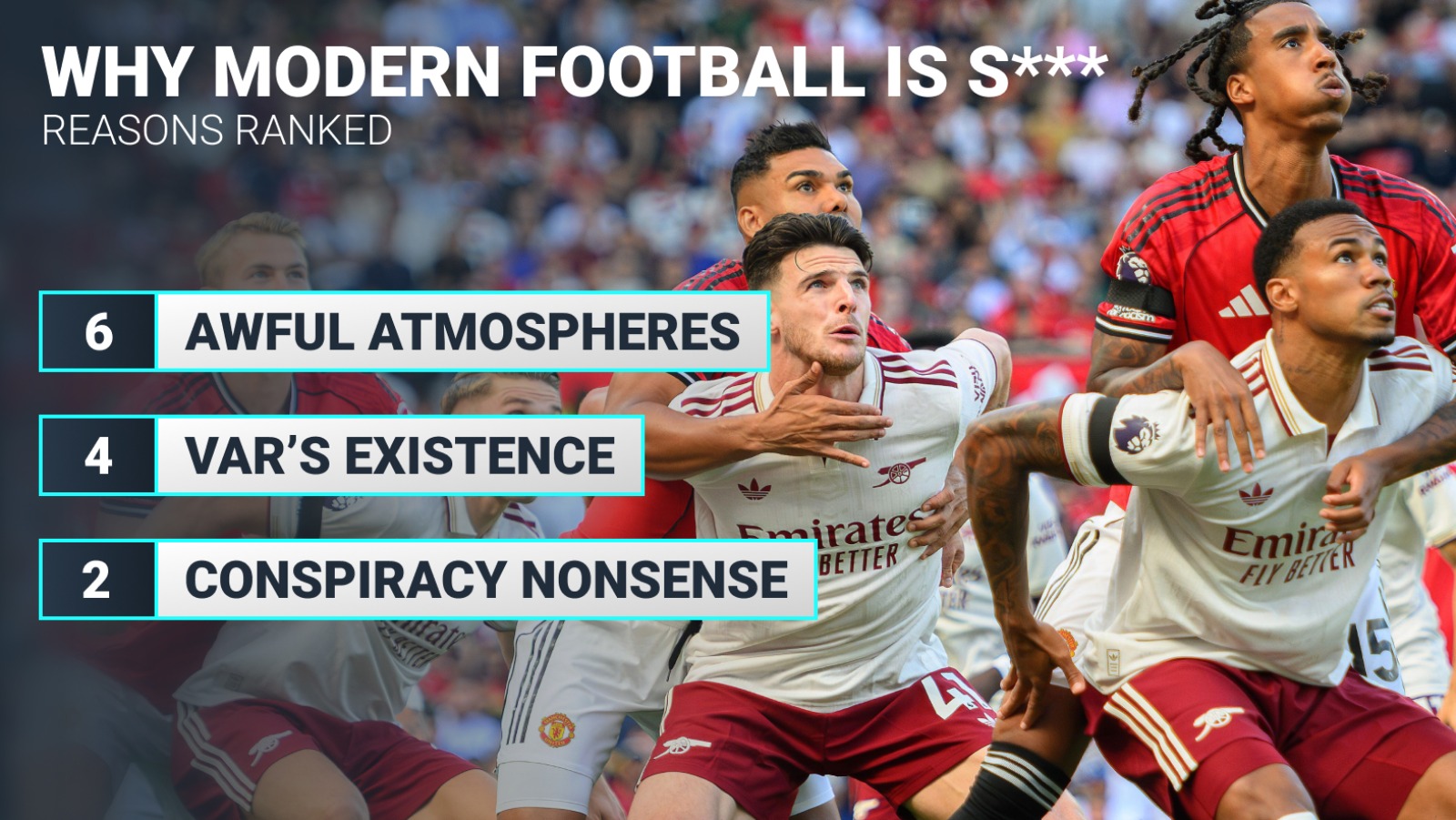
6. The Vanishing Atmosphere
Premier League grounds used to feel alive. Now? They feel like corporate hospitality events with football happening in the background.
Ticket prices have priced out the lifeblood supporters. Clubs have done the maths and realised that fifty tourists spending once each generates more revenue than one loyal fan attending fifty times. New stadiums, however impressive architecturally, can't replicate the ghosts of the grounds they've replaced. Everton's departure from Goodison Park this year symbolises the loss perfectly—Hill-Dickinson may be state-of-the-art, but it won't have Goodison's raw power.
Leeds have been the exception this season, a throwback to when atmosphere meant something. Elland Road still feels different. But they've rather undermined their own credentials lately. The problem runs deeper than any individual stadium, though: fans are viewed as revenue streams to be squeezed, not communities to be nurtured.
5. The Consistency Paradox
Here's the thing about modern football discourse: we demand consistency and common sense in equal measure, never realising they're mutually exclusive.
The Haaland-Szoboszlai incident at Anfield was the perfect case study. City were winning either way. Liverpool were losing either way. Strip away tribal allegiances and what emerged? Two equally valid perspectives that fans pretended not to understand because it played better to their galleries.
Playing an advantage doesn't mean you get to commit fouls afterwards—that's anarchy. But equally, there's something that feels like natural justice in a City goal after that sequence. Both things are true. Both things are reasonable. And yet the moment the next marginal contact in the box gets penalised, everyone's suddenly furious about inconsistency again.
We want common sense until we want consistency. We want consistency until common sense suits us better. It's a circle that will never be squared.
4. VAR Simply Existing
Almost everything wrong with football traces back to VAR. The killed momentum that destroys atmosphere. The decision-by-committee that feeds conspiracy theories. The false promise that perfect decisions are possible in a sport built on infinite shades of grey.
One official making a snap judgement in real time? We can live with the occasional mistake. But VAR's deliberation and visibility make mistakes feel intentional. When a goal is chalked off for a push in one game and allowed in another, it's no longer just inconsistency—it's proof of a fix, or so the thinking goes.
The method was supposed to deliver the impossible dreamland. Instead, it's created zero tolerance for marginal calls while having zero ability to eliminate them. VAR has weaponised the very grey areas it promised to clarify.
3. The Offside Absurdity
Goal-line technology is fine. A ball is either over the line or it isn't. Measurable. Objective. Done instantly. No mission creep.
Everything else VAR does should be launched into the sun, starting with offside.
The pixel-peering, the semi-automated shoulder-blade detection, the debate over which frame constitutes the moment of release—it's all theatre. We're pretending we can measure to millimetre accuracy something that was never designed to be measured that precisely. Nobody demanded technological intervention because they'd spotted a toenail in an offside position on a freeze frame.
Worse, we're bending the game to accommodate VAR rather than the other way around. Wenger's grand plan for offside reform would be worse than what we had, worse than what we have now, and possibly the end of football as we know it.
The real crime? We've stolen the purity of the goal celebration. That moment of unbridled joy is now poisoned by the knowledge that someone in a dark room might be measuring someone's armpit.
2. Conspiracy Madness
Football fans were always prone to imagining agendas. VAR has turbo-charged this tendency.
When decisions were made in real time by one official, you could accept the occasional shocker. Now that they're made by committee in the shadows, every decision feels orchestrated. The Premier League apparently spent years preventing Arsenal from winning the league, and now they're desperate for Arsenal to win it. Spurs are being systematically relegated based on a social media intern's banter post about a goalkeeper. Every referee's birthplace is memorised like scripture.
It's exhausting. And it's VAR's fault for making the decision-making process visible enough to feed the paranoia but opaque enough to seem suspicious.
1. The Set-Piece Wrestling Epidemic
This is what people mean when they say football is broken now. Not just that there are more set-piece goals—that there's barely any refereeing at all in the box. Everyone fouls everyone, so nobody gets penalised.
Arsenal have become the lightning rod for this, not because of some anti-Arsenal conspiracy but simple mathematics: more people dislike Arsenal than support them, so their methods draw the most criticism. But they're far from alone—they've just perfected the dark art.
The solution sounds simple: one referee, one decision. He picks an offence, stamps it out with a free-kick. One weekend of coordinated clamping down and it's sorted. But try that now after months of allowing these goals and you've got the consistency mob screaming bloody murder, even though they're the same people who'd demand common sense if it suited them.
There are so many concurrent fouls in modern corners that VAR is powerless—how do you make a clearly correct decision about ten simultaneous offences? It's like Mr Burns' diseases keeping each other at bay. Go back to a single referee and he can simply choose which foul to penalise.
At the end of the day, all we're asking for is common sense. Which, of course, is precisely what we can't have.
Compare options