Arsenal's Title Destiny Sealed as Pickford's Howlers Gift Gunners Victory Over Everton
The arithmetic looks increasingly bleak for Manchester City. Even accounting for Arsenal stumbling in the coming weeks, Pep Guardiola's side simply lack the consistency to mount a credible challenge. Arsenal have simply been the superior outfit this season—the goals matter equally whether they arrive from set pieces or long-range efforts, and on the balance of play, the Gunners merit their position.
Dowman's emergence as a match-changer cannot be overlooked. The composure displayed by a player of such tender years, sprinting the full length of the pitch before finishing with clinical precision, represents something special. The teenager transformed the contest from the moment he stepped onto the pitch, and his two crucial late strikes—particularly the stoppage-time breakaway—showcase maturity well beyond his years. Balancing GCSEs with performances of this magnitude raises questions about focus, yet Dowman has answered them emphatically.
Pickford's Collapse Under Pressure
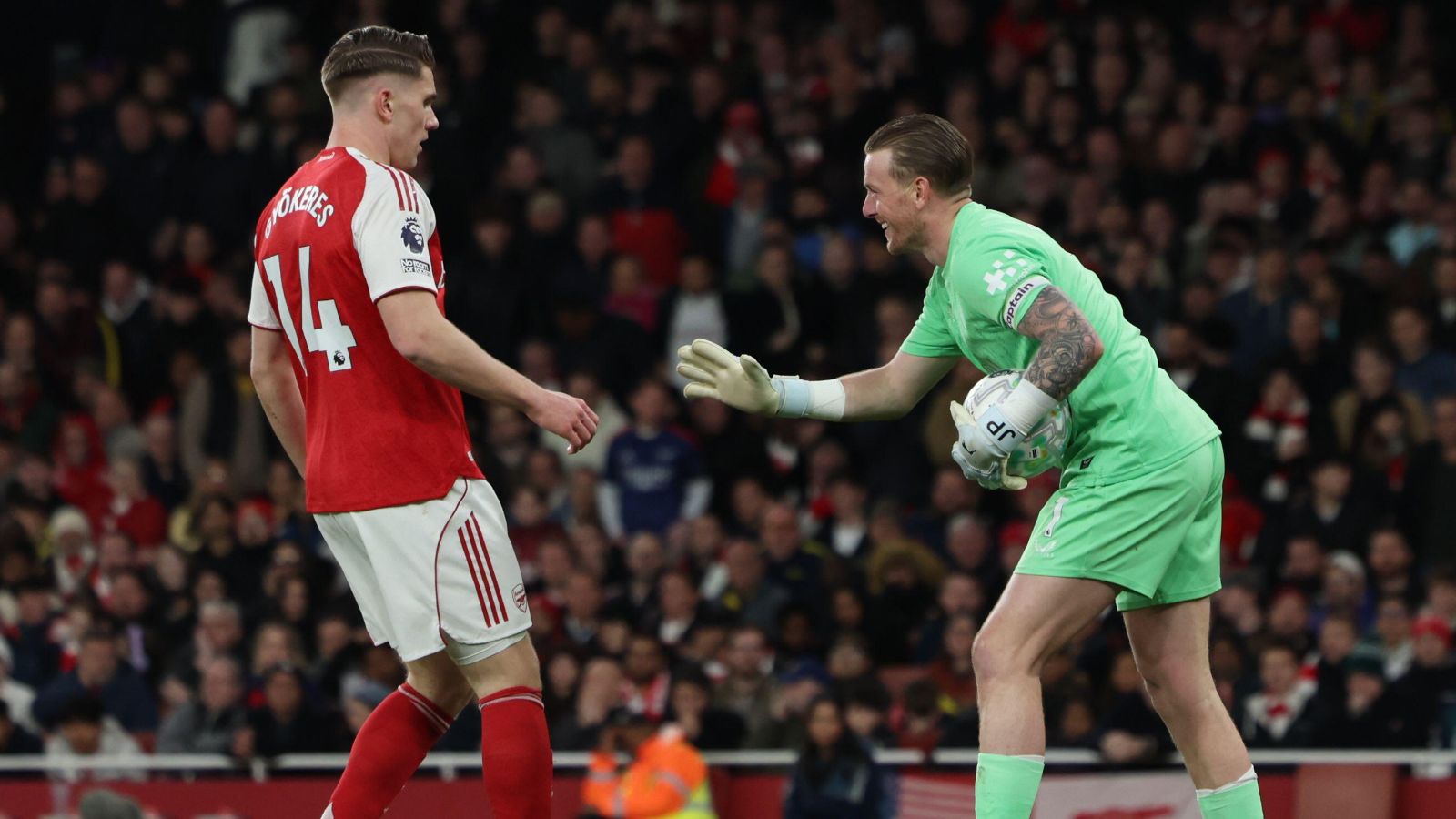
Yet Dowman's brilliance cannot mask Everton's catastrophic goalkeeper display. Jordan Pickford's reputation as an elite shot-stopper deserves serious interrogation following this shambles. His performance served up Arsenal's victory on a silver platter, with two egregious errors in the closing stages transforming a hard-fought contest into a gift.
The 89th-minute opener stemmed directly from his recklessness. Dowman's whipped cross from the right presented a straightforward proposition, yet Pickford charged out impetuously, made the barest contact, and failed to command his area. A goalkeeper of genuine quality either punches clear or remains composed. Instead, his misjudgement handed Dowman the opening.
The stoppage-time farce proved even worse. With Everton desperately seeking an equaliser, Pickford abandoned his post for an attacking throw-in—a decision reeking of ego rather than tactical nous. Arsenal cleared, possession shifted, and the 16-year-old simply sprinted the entire pitch before rolling into an empty net. Pickford remained stranded upfield, seemingly oblivious to his fundamental responsibility. He didn't even begin chasing until Dowman's path to glory became inevitable.
This represents no isolated aberration. Pickford's career follows a familiar pattern: spectacular early saves masking a deeper fragility when matches hang in the balance. His performative theatrics, the constant gesticulating at defenders, the theatrical distribution—all mask a keeper who buckles when it matters most. Arrogance and complacency, compounded by sheer indolence, have cost his team dearly. The volume of England caps this man has accumulated remains genuinely baffling.
VAR's Questionable Judgment
Amidst the celebrations, a troubling VAR decision nearly altered the narrative entirely. Kai Havertz broke through one-on-one with Pickford only for Michael Keane to tread upon his heel. The referee, poorly positioned, understandably missed the contact. VAR, however, cleared the incident within mere seconds, citing "minimal contact."
When did "minimal contact" become grounds for dismissing a penalty? The law of the game makes no such distinction. Havertz, already beyond his marker, possessed every right to his line. Keane made no attempt to play the ball, simply treading on the Arsenal forward's planted foot. The notion that Havertz initiated contact holds no water.
This inconsistency reeks. Earlier this season, Nick Pope received no such mercy for "minimal contact" whilst dispossessing Gyokeres. Either contact matters, or it doesn't. PGMOL's selective application suggests a neutrality problem that extends beyond mere incompetence. Observers noted considerably lighter contact awarded as fouls elsewhere during the same match.
The Bigger Picture
Beyond this individual fixture, questions linger about modern football's trajectory. The sport has evolved into something resembling an industrial process—systems, structures, pressing triggers, data analytics, heat maps, presumably even sleep-cycle monitoring somewhere. The result? Incredibly athletic players executing incredibly efficient football. Yet something intangible has been lost.
Everyone presses identically. Everyone tracks runners. Everyone comprehends their tactical role to the centimetre. The individuality that once defined football—the ability to simply decide five defenders weren't your problem—has been systematically coached out of young players around age fourteen.
Compare today's wingers to figures like Ginola, who simply ignored full backs when the mood struck, or Kinkladze, who appeared accidentally transported from five-a-side onto the Premier League pitch. These players made it up as they went along. Modern football tolerates no such luxury. Contemporary wingers press, cover sixty yards when possession changes, and probably possess spreadsheets detailing optimal crossing angles.
The game has become optimised into blandness. Set pieces resemble NFL plays. Titles get won through grinding efficiency rather than excitement. VAR arguments plague every weekend. Rules nobody fully comprehends get enforced inconsistently. Arsenal grind through matches, winning matches without inspiring anyone to rearrange their Saturday plans.
This represents progress, certainly. Fitter athletes, smarter tactics, superior analysis. Yet something irreplaceable has vanished—the chaos, the flair, the unpredictability. Somewhere exists a kid capable of becoming the next Cantona or Ginola. Instead, he's being instructed to press the full back, track runners, and maintain team shape. If fortunate, he'll become an exceptionally well-organised winger.
Football has become Formula One with shin pads. The thrill, somehow, has gone.
Compare options