Arsenal's Champions League Final Defeat Overshadowed by TNT's Cringe-Worthy Broadcast
Football has long since ceased to be merely a sport. Plagued by self-doubt, the industry has turned its back on its core audience in pursuit of the mythical "floating viewer" – that phantom demographic that supposedly guarantees ratings gold.
Yet TNT Sports' handling of the Champions League final represented something far more troubling: a masterclass in how not to cover a neutral event, wrapped up in a package of hollow entertainment and abandoned pretence.
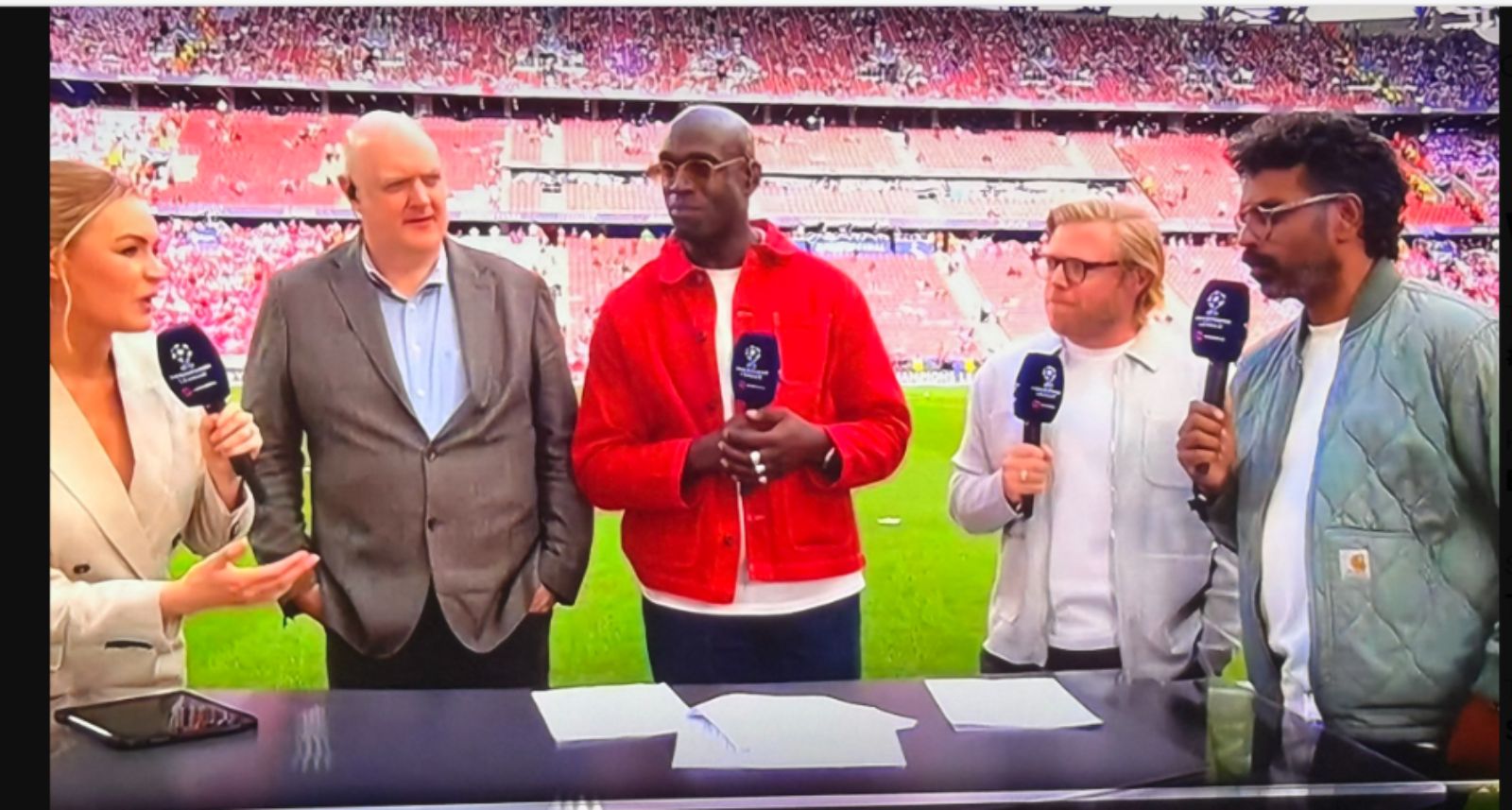
The pre-match build-up saw Dara O Briain, Rob Beckett and Romesh Ranganathan wheeled out in what felt like a Greatest Hits compilation of Mock the Week circa 2010. None of the trio offered anything of substance – no genuine insight, no shared understanding, nothing that might genuinely enrich a viewer's anticipation of what was to come. Instead, it felt like pure star-gazing from TNT, a desperate flex to justify their roster. Fair play to Beckett and Ranganathan for the exposure, mind you – apparently they're available for modest fees and suitable for most occasions.
Jack Whitehall's appearance only reinforced the sense that someone had assembled every stereotype of a Russell Group university football bore into human form.
When it came to the expert analysis, the bias became impossible to ignore. Having a handful of Arsenal-sympathetic voices was perhaps forgivable for the club's biggest match in two decades. That they dominated the entire punditry operation was considerably less so.
Laura Woods fronted proceedings. Jack Wilshere, a talented midfielder before injuries derailed his career, has proven about as natural in the studio as a fish on a bicycle, serving up the sort of observations you'd hear from any bloke at the pub. Martin Keown, that perpetually scowling former Gunner, actually managed to talk some sense about Noni Madueke's extra-time penalty appeal – a rare moment of clarity in an otherwise one-sided affair. You'd struggle to find three pundits less equipped to cover a mid-afternoon World Cup qualifier between Poland and Saudi Arabia, yet their allegiance to Arsenal superseded everything else.
The commentary team – Darren Fletcher, Ally McCoist and Steven Gerrard – proved equally problematic. Social media had already circulated a "Darren Fletcher bingo card" pre-match, complete with his trademark tics: "irrelevant stat," "listen to the noise inside this place," and the withering "gives opinion."
All commentators eventually become self-parody. Fletcher, however, lacks the warmth that once surrounded figures like Motson, Davies or Tyldesley. When Kai Havertz opened the scoring, Fletcher's cry of "One-nil to the Arsenal has a nice ring to it" dripped with barely concealed glee, clearly already composing the post-match highlights reel in his head.
It deteriorated from there. Over the course of 90 minutes, the entire broadcast team treated Arsenal like proud parents potty-training a toddler, conveniently glossing over the fact that PSG dominated with 76 per cent possession and Arsenal managed just one shot on target. There was also the particularly grating moment when Fletcher insisted Warren Zaire-Emery should be getting more minutes for PSG – a claim that crumbles instantly when you discover Zaire-Emery had accumulated the most Ligue 1 minutes and the fourth-most in the Champions League.
Fletcher would undoubtedly have known this. Commentators spend days meticulously preparing both teams. Instead, he led with opinion over fact, leaving viewers worse off for it.
Extra-time brought no relief. Fletcher announced that Arsenal hadn't been awarded a penalty all season, then twice butchered the definition of irony. When Madueke went down in the box, Fletcher asked McCoist whether he'd "seen them given," and Gerrard nodded along – despite acknowledging that the Arsenal player had actually grabbed Nuno Mendes' arm.
Later, after Gabriel's penalty sailed towards the Slovakian border, TNT offered sympathetic platitudes about his disappointment. Easy to forget, of course, that he's arguably the Premier League's most theatrical defender – this generation's John Terry moment, if you will.
Yes, it's natural to get swept up in the moment, to feel emotion override objectivity during sport. But these broadcasters were tasked with covering a global showpiece. They were paid to observe events impartially, not to broadcast their own prejudices across millions of screens.
Even the trophy presentation wasn't spared, with an ad break cynically inserted roughly three seconds after PSG lifted the cup.
It's genuinely unclear who TNT imagined this coverage was for. Yes, broadcasters chase "clickable content," but social media consensus from Budapest was uniformly damning of their output. Beyond the cringe-inducing celebrity insertions, football broadcasters must abandon the practice of having fans cover their own club. Sky Sports renders Manchester United and Liverpool matches unwatchable through Neville and Carragher's combined efforts. Despite holding a monopoly on European coverage and the chance to do something genuinely different, TNT has spent a decade copying the worst elements of this broken model.
Here's the uncomfortable truth: nothing about TNT's broadcast enhanced anyone's experience of that final. Arsenal supporters had their minds elsewhere. Casual viewers and those who'd tuned in for the pre-match entertainment would have found most of it sailing over their heads. Everyone else simply felt alienated and annoyed.
The coverage hasn't meaningfully improved since Jake Humphrey and Rio Ferdinand departed.
Football remains the world's most popular sport. The Champions League final is club football's biggest occasion. If you cannot let the football speak for itself under those circumstances, then the game has truly lost its way.
Compare options