The Premier League's 2025/26 Prize Money Breakdown: Who's Banking What
The Premier League's financial waterfall keeps flowing, and for the 2025/26 season, the distribution model is worth understanding—particularly with a fresh television deal about to reshape the landscape.
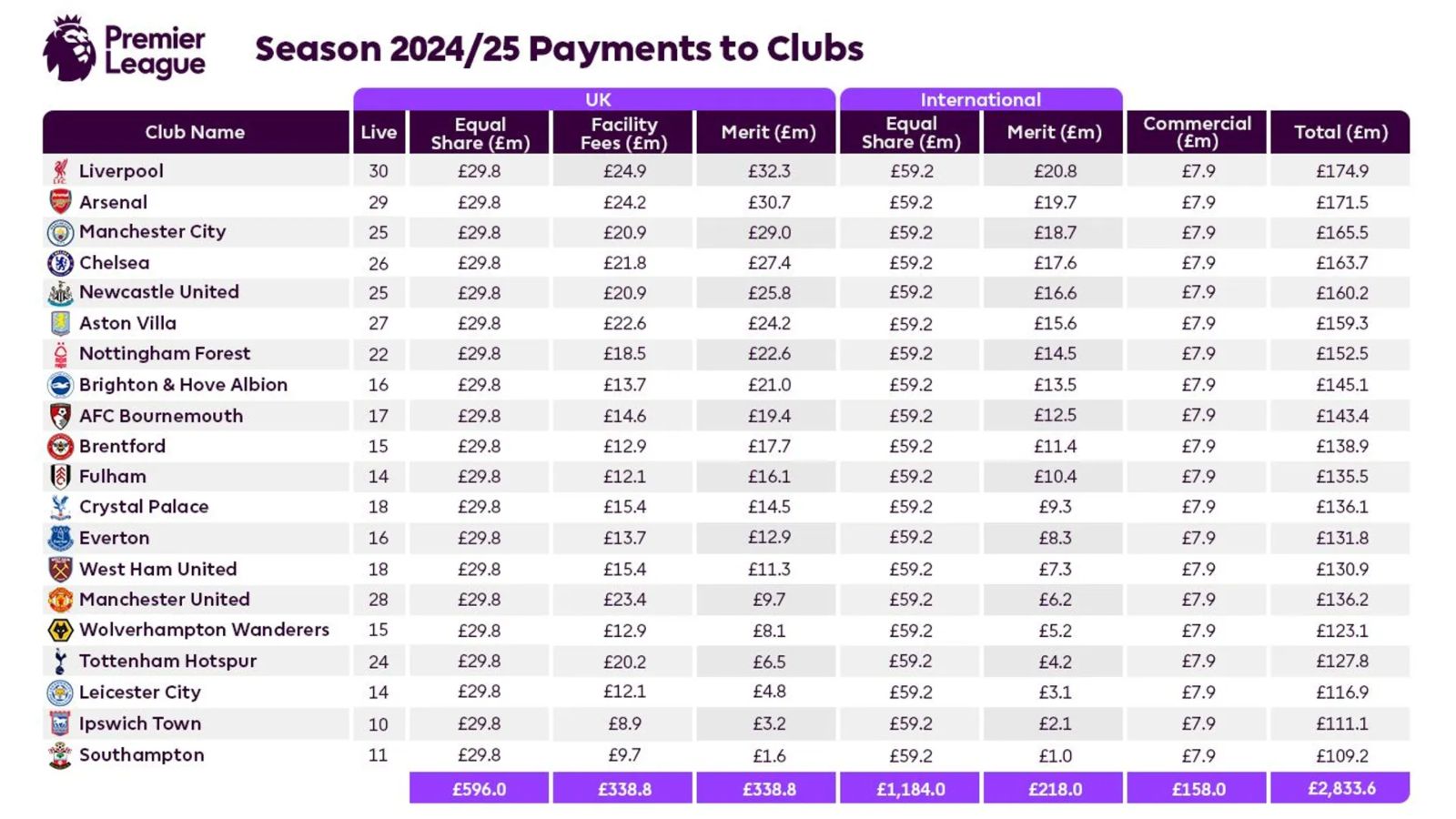
Last season, the 20 Premier League clubs shared £2.83bn between them. That's the kind of money that makes even finishing rock-bottom a respectable earner: Southampton pocketed £109.2m for their wooden-spoon finish. The league's central revenue system, as the Premier League proudly notes, represents "the most equitable distribution of funds of any major European league."
Liverpool collected £174.9m as champions—falling just shy of Manchester City's 2022/23 record of £176.2m—while Newcastle banked just over £160m to add to their PSR concerns.
The Fixed Pot
Every club receives roughly £96.9m automatically. This comprises three components: the equal share from domestic broadcast deals (£29.8m), international rights (£59.2m), and central commercial revenue (£7.9m per club). These figures are locked in regardless of performance or television exposure.
The Variable Game
Beyond that guaranteed slice, earnings become a meritocracy. Merit payments cascade down from first to twentieth place on a sliding scale, with approximately £2.7m separating each position in 2024/25. The champions picked up £53.1m in merit payments, while twentieth place earned £2.7m—a difference that essentially funded Southampton's entire summer transfer business.
Arsenal, currently leading the table, would bank around £53.1m if they finish first. The gap between positions has historically fluctuated slightly with inflation; it was around £2.8m per place in 2023/24, so expect similar variance this season.
The Broadcast Lottery
Here's where things get interesting. Facility fees—payments tied to how many times a club's matches are selected for live television—can create significant disparities.
Last season, Liverpool appeared 30 times on UK television and received £24.9m in facility fees. Arsenal's 29 televised matches earned them £24.2m. Meanwhile, Ipswich's ten televised fixtures netted just £8.9m. This disparity occasionally produces bizarre outcomes: Manchester United finished 15th last season but earned £136.2m overall—more than four clubs who finished above them—because Ruben Amorim's side received substantially more televised fixtures. Tottenham similarly outearned Wolves from a lower league position thanks to superior broadcast selection.
The New Deal Changes Everything
Beginning in 2025/26, a record £6.7bn domestic television deal transforms the landscape. The number of live fixtures explodes to 267 of a possible 380—essentially every match outside the protected Saturday 3pm slot will be broadcast.
Sky Sports secured four of five packages and will show 215 matches, guaranteeing at least four Premier League games per gameweek plus all ten fixtures on the final day. Their schedule includes Saturday 5.30pm, Sunday 2pm, and Sunday 4.30pm slots, plus Monday and Friday evening matches and three midweek rounds. TNT Sports maintains their 52-match allocation, including all Saturday 12.30pm kickoffs and two midweek rounds. The BBC continues with a weekly highlights package.
International rights now exceed £2bn annually, with new agreements in Japan and Mexico joining established lucrative deals across America, Scandinavia, Thailand, China, India and beyond.
Where The Money's Going
Based on 2024/25 payments and the new broadcast selections confirmed through Boxing Day, estimated 2025/26 payouts look like this:
Arsenal lead at approximately £177.4m, with Manchester City second (£174.9m) and Manchester United third (£172m). Aston Villa and Liverpool follow with £168.5m and £165.9m respectively. Chelsea edge to £158.8m.
The mid-table pack clusters tightly: Bournemouth (£154.3m), Brentford (£150.6m), Brighton (£149.8m), and Newcastle (£148.3m). Sunderland, Everton, and Fulham occupy the £139-144m range.
The bottom half sees sharper drops. Spurs project £135m despite their league position, while Crystal Palace, Nottingham Forest, and West Ham range between £126-132m. Burnley and Wolves trail significantly at £116.7m and £115.8m respectively—a difference of roughly £900,000 that could prove decisive in their survival battle.
These figures assume similar inflation and operational costs to the previous season. The actual amounts will inevitably shift based on economic factors, but they provide a reliable roadmap for how clubs should budget their 2025/26 campaigns. Even for those battling relegation, Premier League membership remains extraordinarily lucrative.
Compare options